


Anyone shortlisting food waste tracking systems runs into the same problem: every vendor's comparison page describes competitors a little differently than those competitors describe themselves.
That's normal in B2B software, but it makes it hard to know what's actually true about a system you haven't tested yet.
This page goes through the claims about Winnow that show up most often in competitor comparisons, checks them against how the product actually works today, and explains the technical detail behind each one.
Winnow Alternatives Claims vs. Winnow
What alternative solutions say about Winnow |
What is true for Winnow today |
|
"Winnow captures waste inside the bin, after items have mixed together. [Competitor] claims that users throw food away in the usual way" - This is not true. |
Winnow photographs food at the moment it enters the bin, capturing a burst of 30+ images per disposal and selecting the clearest frame, so each item is recorded before it reaches anything already in the bin. Because capture is automatic, no disposal can be skipped: staff bin food exactly as they normally would, with no scanning step to remember and no waiting with a tray held up until a scan completes. |
|
"Winnow logs only one ingredient per disposal." - This is not true. |
Winnow identifies both individual ingredients and composite dishes, so the "ingredient-level" framing understates what the system captures. It also points at the wrong problem. In kitchens that prepare food in advance, chefs rarely find single items hard to log. The bulk of waste comes from overproduction: whole trays of food discarded from a single gastronorm after service. That is the waste stream a measurement system needs to capture accurately. |
|
"Most Winnow devices are wall-mounted and need a technician, so rollout is slow." - This is not true. |
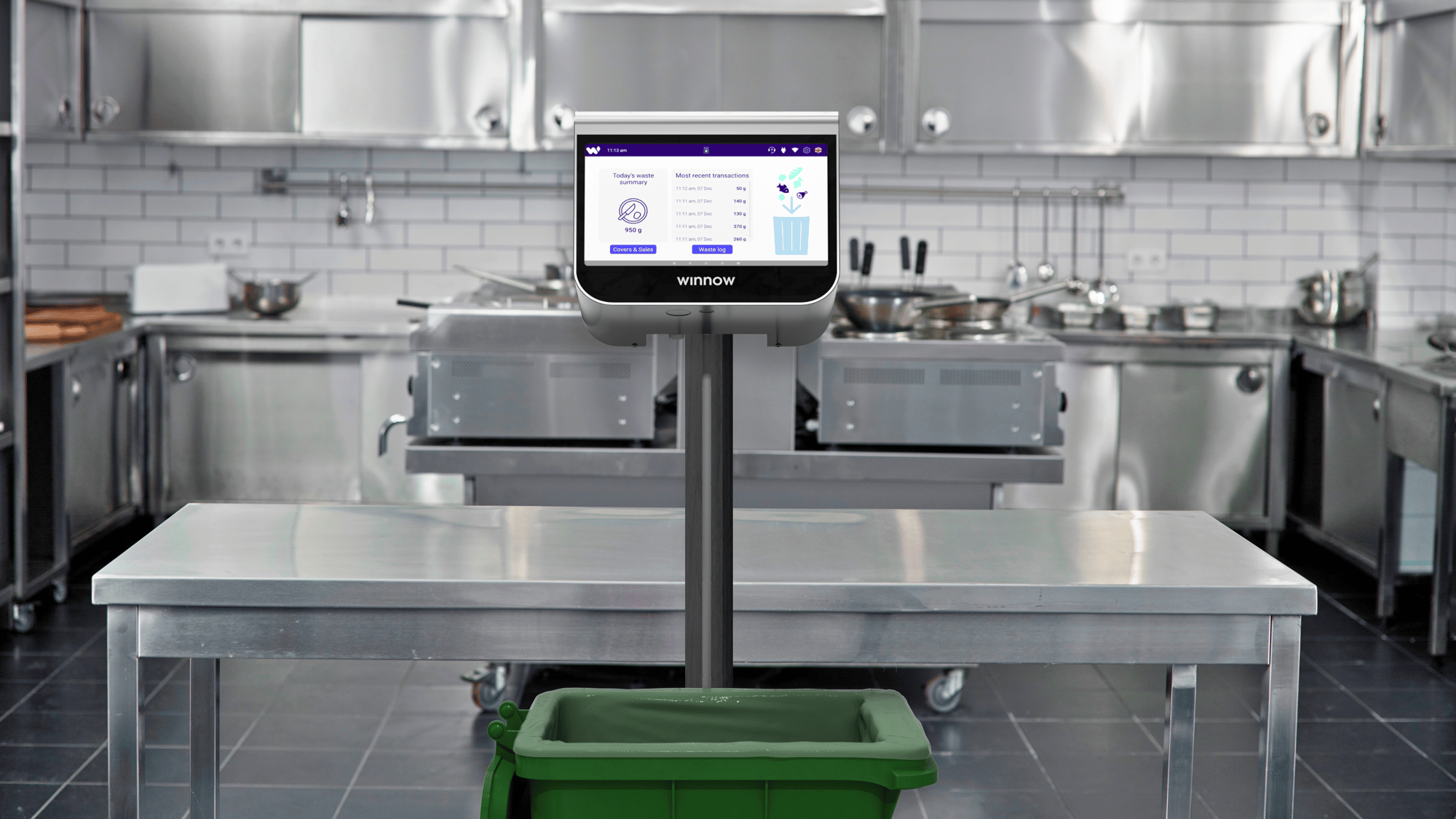
Winnow units can also be pole mounted or free standing, and the setup can be assembled within 15 minutes with no technician or IT involvement. |
|
“[Competitor] claims sites do not need training for kitchen staff compared to Winnow.” - This is not true. |
Said competitor runs an onboarding programme of its own, so the no-training claim doesn't hold up. Training actually matters more in a scan-first system, not less. If someone hasn't been briefed, say an agency cook on a busy Saturday, they can bin food without scanning it and that waste simply never gets recorded. With Winnow the capture is automatic, so even a brand-new team member can't accidentally skip a disposal. The real question isn't who needs training, it's what happens to your data when someone forgets. |
|
"Winnow only offers API access on an Enterprise plan." - This is not true. |
Winnow has different tiers and products matched to kitchen sizes. Data can be downloaded by any user and filtered by date, food type and more, and Winnow's integrations go beyond an API. |
|
"Winnow does not publish an accuracy figure." - This is not true. |
Winnow's AI is 80% accurate, and that figure covers 100% of everything thrown away in the kitchen. Each disposal is also processed in real time, so staff see the result on the screen straight away and can fix any mistakes on the spot. You may see higher accuracy rates reported by competitor systems. However, these are systems where staff can bin food without recording it, sometimes missing more than 30% of total waste, and where there is no way to check the photo at the time. A high score on incomplete data still means the kitchen gets an incomplete picture of its costs. |
|
"Lower Winnow tiers still need manual staff input, which slows the kitchen." - This is not true. |
Winnow's tiers are matched to kitchen size, not stripped-down versions of each other. Waste Track is designed for kitchens with lower food production, where a few seconds of input per disposal fits naturally into service and doesn't slow anyone down. Kitchens with higher volumes use Winnow Vision, where capture is fully automatic. As a kitchen's production grows, the system scales with it. |
Questions to ask any vendor, regardless of which comparison page led you there
Vendor comparison pages describe capture methods, install timelines, and accuracy using whichever framing favors their own product. The fastest way through that noise is to ask every vendor the same five questions and require the answers in writing, by device model and site count, rather than accepting marketing language as a substitute for a spec.
- What does your current top-tier device actually capture per disposal? Ask for the spec by device model, not a category-wide claim.
- What's the install process for a 20-site rollout? Get a written timeline, not "compact and easy to install."
- Does accuracy change with staff turnover? Touchless systems shouldn't. Manual-input tiers usually do.
- Can you see a live customer dashboard from a group your size? Case studies are marketing. A live dashboard walkthrough is verification.
- What happens to your data if you switch providers? Export terms matter more once you've got two years of site-level history.
Why this matters more for hotel and catering groups looking to buy
A single-site restaurant can tolerate a system that needs occasional staff input. A 40-property hotel group can't. Inconsistent data collection at even 10% of sites breaks cross-site benchmarking, which is usually the entire reason a group buys a portfolio-wide system in the first place. This is the criterion that should carry the most weight in an RFP, ahead of headline accuracy percentages that are often measured under different conditions by different vendors.
Frequently asked questions
What are the main alternatives to Winnow?
Most alternatives fall into four groups: no-touch AI capture at the bin, above-bin cameras that record items before disposal, connected smart-scales that weigh waste, and scan-based systems where staff present pans before and after service. They differ mainly in how much work they ask of the kitchen and how complete the data stays across shifts.
How is Winnow different from other food waste tools?
Winnow's Throw & Go records waste with no extra step from staff, in under a second, and covers both pre- and post-consumer waste. It is the most widely deployed option in hospitality, with published savings of 2-8% on food cost and over $100M saved globally each year.
Does Winnow need a technician to install?
No. Winnow is built to go live without a technician or IT involvement. Winnow units can also be pole mounted or free standing, and the setup can be assembled within 15 minutes with no technician or IT involvement.
Do food waste systems slow the kitchen down?
Manual and scan-based systems add a step at the point of disposal, which teams often skip during busy service. No-touch capture does not, because staff bin waste exactly as they always have and the AI records it in the background.
How quickly do kitchens see a return?
Winnow customers typically see 2-10x ROI in the first year and cut food costs by 2-8%. Ask any vendor for audited results across a portfolio similar to yours, not a single best-case site.
What's the biggest risk in relying on a vendor's own comparison page?
Vendor comparison pages describe competitors using whichever spec, often an older or lower tier, makes the comparison most favorable. Cross-check any specific technical claim (capture method, install process, accuracy rate) against the competitor's own current spec sheet or a live demo before it factors into a buying decision.





Comment on my blog