


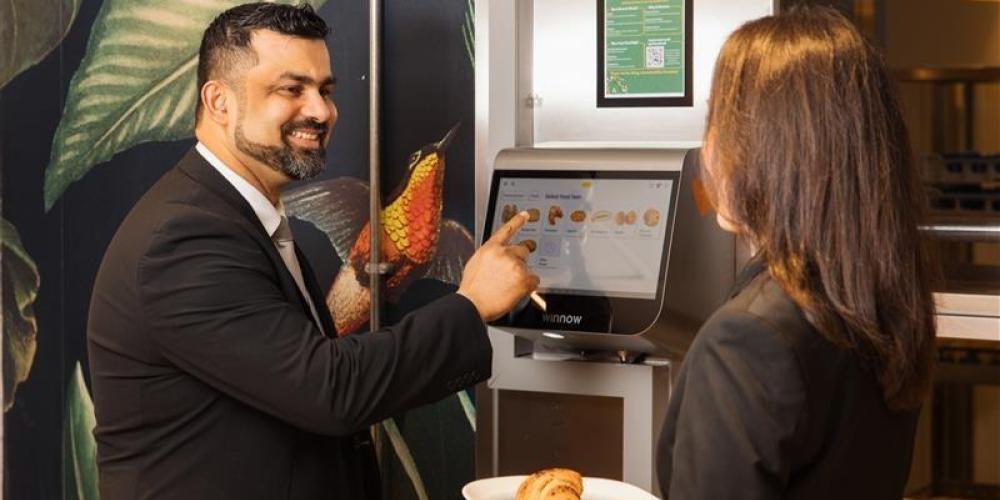
At The Peninsula London, luxury is defined by precision, generosity and detail. Guests are free to enjoy exactly what they want, when they want it. Behind the scenes, Antje Balow, Head of Corporate Responsibility and Sustainability, and Cicero Silveira, Colleague Facilities Manager at The Peninsula London, are working to answer a critical question: how can a hotel built on generosity reduce unnecessary waste?
For Antje, reducing food waste is a core business responsibility. “With luxury comes generosity,” she says. “But built into that can be wastefulness. If we want to sleep at night, we have to manage that responsibly.”
Cicero puts that responsibility into action. He oversees colleague facilities across the hotel, including the staff restaurant serving around 800 daily covers. Since installing Winnow in the staff restaurant, he has used data insights to reduce waste while maintaining the same quality and experience. The result has been a 40% reduction in food waste.
“Resources are limited,” Cicero says. “If we make small changes together, it helps the planet and it helps the hotel operate better.”
The missing connection
In April 2025, The Peninsula London introduced Winnow in its staff canteen to measure food waste. For Antje, the technology revealed an important operational gap.
“What Winnow solves for us is the disconnect between the people who buy and make the food and the ones who manage the bins,” she explains.
In many hotels, stewarding teams manage waste while chefs focus on production and service. The two do not always intersect in a way that provides feedback. The data created that missing link, giving teams clear visibility into what was being discarded and why.
For Cicero, seeing the images and numbers together was eye-opening.
“When you see the pictures and the numbers together, it really opens your eyes,” he says. “Even small things you don’t think about can add up to a lot.”
Precision without compromise
Once the team had clear data, Cicero began identifying practical ways to reduce waste without compromising the dining experience. One of the first insights was the amount of fresh produce being discarded.
“Tomatoes don’t seem very expensive,” Cicero says. “But when you collect the data and add the numbers together, you realise how much we were actually wasting.”
The team replaced pre-cut tomatoes with cherry tomatoes in the buffet, which stay fresh longer and can be reused if untouched, leading to a 41% reduction in tomato waste.
Cucumbers were also cut into thinner portions, encouraging colleagues to take smaller servings while still having the option to return for more.
The improvements did not come from restricting choice but from smarter operational decisions that protect the dining experience while reducing waste. “It just takes a little bit of thinking,” Cicero adds.
Other actions included:
- Refining buffet timing to better match demand
- Introducing smaller serving containers toward the end of service
- Cooking rice in smaller batches and adjusting replenishment schedules
- Repurposing surplus bread into croutons, paninis, toasties and bread and butter pudding
- Storing bread in containers to keep bread fresh for longer
Results
- 40% reduction in food waste
- £41,000 annualised reduction in food waste value
- 11.2 tonnes of food waste prevented each year
- 48.3 tonnes of CO₂ emissions avoided annually
- 28,000 meals saved per year
Scaling the impact
The staff canteen was only the starting point. The Peninsula London now plans to implement two additional Winnow systems in other venues across the property.
For Antje, the goal is to embed the same visibility and discipline across all culinary operations. With Cicero leading the staff canteen programme, the next phase will extend these practices across additional kitchens throughout the hotel.
A shared responsibility
For Cicero, reducing food waste ultimately comes down to awareness.
“A lot of energy goes into producing food,” he says. “Growing it, transporting it, preparing it. When we waste less, we respect all that effort.”
At The Peninsula London, luxury and responsibility go hand in hand. Through careful measurement, practical operational changes and collaboration across teams, Antje Balow and Cicero Silveira are turning data into action and setting a strong example for sustainable hospitality.
For other hotels considering their own food waste journey, their advice is simple:
“Just do it. You can look at it commercially, environmentally or ethically. It always makes sense. There is no world in which this is not a good idea.”




Comment on my blog