


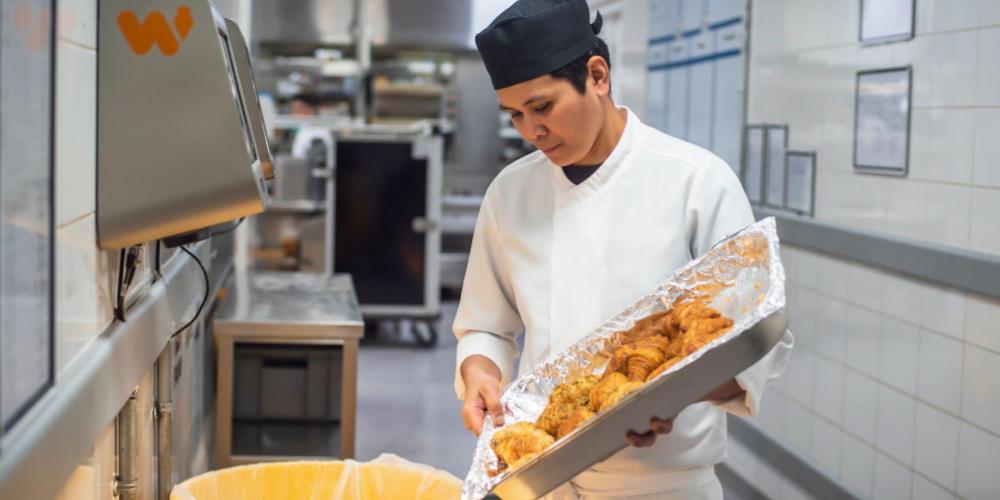
All-inclusive resort buffets typically produce more food than is needed because operators trade visual abundance for the risk of running out. AI-based food waste tracking removes that uncertainty by recording what gets thrown away automatically, surfacing patterns chefs cannot see by eye, and feeding daily production decisions that bring output closer to actual consumption. Resorts using Winnow's AI typically cut food cost by 2% to 8% without changing the guest experience. Royalton CHIC Cancun cut waste 56% in six months at one buffet using exactly this loop.
Key facts
- Buffets overproduce because of operational uncertainty, not chef intent
- AI removes the guesswork by capturing waste automatically and surfacing patterns by dish, station, and service period
- Resort kitchens using Winnow typically see 2% to 8% reductions in food cost
- Adjustments are gradual and largely invisible to guests
- Royalton CHIC Cancun cut food waste 56% in six months at one buffet using daily AI insights
- A 2025 survey of 140+ easyJet holidays hotel partners found that 40% of resort operators were not measuring food waste at all, and 48% were using manual methods - meaning the majority are making production decisions without reliable data
Why do resort buffets produce more food than they need?
In all-inclusive resorts, buffets must stay full through service. That single requirement creates an environment where producing more is the safer option. Overproduction is rarely about the chef. It is a consequence of how the buffet operates.
Several factors compound the issue:
- The visual expectation of buffet abundance
- Fear of trays emptying mid-service
- Variability in resort occupancy
- Shifts in guest profile and behaviour
- An operating culture of "prepare extra to be safe"
A second challenge sits underneath. Many kitchens have no daily feedback loop to show clearly what is being thrown away. Without that data, producing more becomes a way to reduce operational risk.
Winnow data from 180 resort kitchens at baseline shows average food waste of 191g per cover. The typical breakdown: overproduction accounts for 23% to 57% of total waste; preparation trim for 20% to 42%. These are the two categories most directly addressable through better data.
Why traditional planning is unreliable in all-inclusive resort kitchens
Traditional production planning relies on historical averages or manual estimates that do not reflect real food consumption. In most all-inclusive hotels, daily production gets calculated using historical occupancy averages, spreadsheets, manual production logs, and estimates based on number of guests served.
The problem is that guest count rarely matches actual food consumption. Two days with identical occupancy can produce very different consumption patterns depending on factors like on-resort activities and whether guests spend more time off-property.
When waste is not tracked consistently, the kitchen has no visibility into what was overproduced, and planning falls back on assumptions instead of real data.
How does AI reduce buffet overproduction?
Winnow's AI reduces overproduction by turning waste data into operational adjustments inside the kitchen workflow. The loop has five steps.
Step 1 — Automatic recording, no manual input. The system captures what gets thrown away through automatic recording with no manual intervention. Waste gets logged inside the existing kitchen flow.
Step 2 — Pattern identification. The AI analyses the data and identifies patterns by dish, buffet station, and service period.
Step 3 — Daily visibility for the chef. Chefs see clearly which items are being overproduced.
Step 4 — Production adjustment. With that information, the team adjusts production volumes for the next service.
Step 5 — Dynamic planning. Over time, planning stops relying on historical averages and starts incorporating real consumption and waste data.
The AI does not replace the chef or the team. Its function is to make visible what happens in the kitchen so operational decisions get made on data instead of assumptions.
Can AI reduce food waste without affecting the guest experience?
Yes. When adjustments sit on consistent data, the reduction is gradual and largely invisible to the guest.
A common concern in buffet operations is that cutting production might affect food availability. Waste data usually shows that certain dishes are consistently produced above real demand. That gap is where the savings live, and gradual adjustments are possible:
- Reducing volumes that always end up wasted
- Identifying dishes with the highest real consumption
- Adjusting replenishment timing during service
At H10 Hotels in Spain, Chef Francisco Delgado observed a counterintuitive effect: smaller, more frequent batches actually made the buffet look better. "The customer finds a more beautiful buffet, with more detail." We call this "Abundance Without Waste" - using shallower display vessels, live cooking stations, and vertical merchandising to maintain the visual sense of plenty with less food.
When production decisions sit on data, waste reduction becomes an operational improvement that does not change the guest experience.
How does AI work in resort kitchens with high demand and multicultural teams?
All-inclusive resort kitchens often run with multicultural teams and high staff turnover. That makes it hard to adopt new operational processes, especially ones that depend on manual recording or extensive training.
Automatic recording with no manual intervention reduces that friction because it sits inside the existing kitchen flow. Visual data presentation makes waste understandable across language barriers. Daily reports let results be shared with the whole team. And because the data persists across seasons, it acts as an operational memory - new staff inherit benchmarks from previous seasons rather than starting from scratch. For seasonal Mediterranean resorts, this is one of the most practical arguments for digital measurement: the institutional knowledge does not leave when the team does.
How resorts measure waste in practice with Winnow
For high-volume resort buffets, the system most operators adopt is VisionAI with Throw & Go. Staff throw food away normally, and the system identifies and weighs each item automatically through AI vision, with no scanning, manual category selection, or workflow change. Daily and weekly reports surface the highest-cost waste items, and the Winnow Hub analytics platform lets multi-property groups compare sites and track corporate reduction targets.
Conclusion
In resorts where the buffet is central to the operation, overproduction is rarely intentional. It is a response to uncertainty about demand.
When that uncertainty gets replaced with clear data on food waste, production becomes more precise and decisions in the kitchen happen with greater confidence. Kitchen teams can adjust volumes gradually and protect the guest experience.
In resorts with high-demand buffets, the difference usually starts with something simple: making waste visible inside the daily operation.
Further resort case studies
- Royalton CHIC Cancun, Blue Diamond Resorts
- Nickelodeon Hotels & Resorts Punta Cana
- The Santa Maria, Luxury Collection Hotel & Golf Resort, Panama (Marriott)
Further reading
Winnow developed A Practical Guide to Reducing Food Waste in Resorts in collaboration with easyJet holidays and UN Tourism, drawing on data from 180 resort kitchens and a survey of 140+ hotel operators. Download it here.
See what Winnow can do in your kitchen. Request a demo →




Comment on my blog